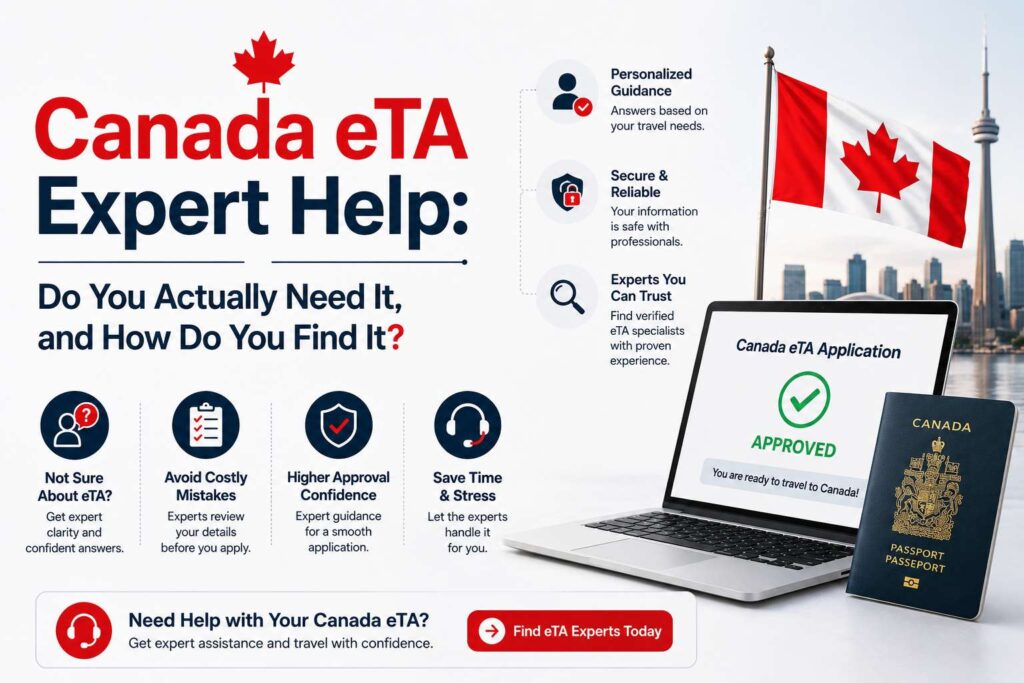
Canada eTA Expert Help: Do You Actually Need It, and How Do You Find It?
Applying for a Canada eTA directly through the government carries a small, fixed processing fee. Search for help…
Read More
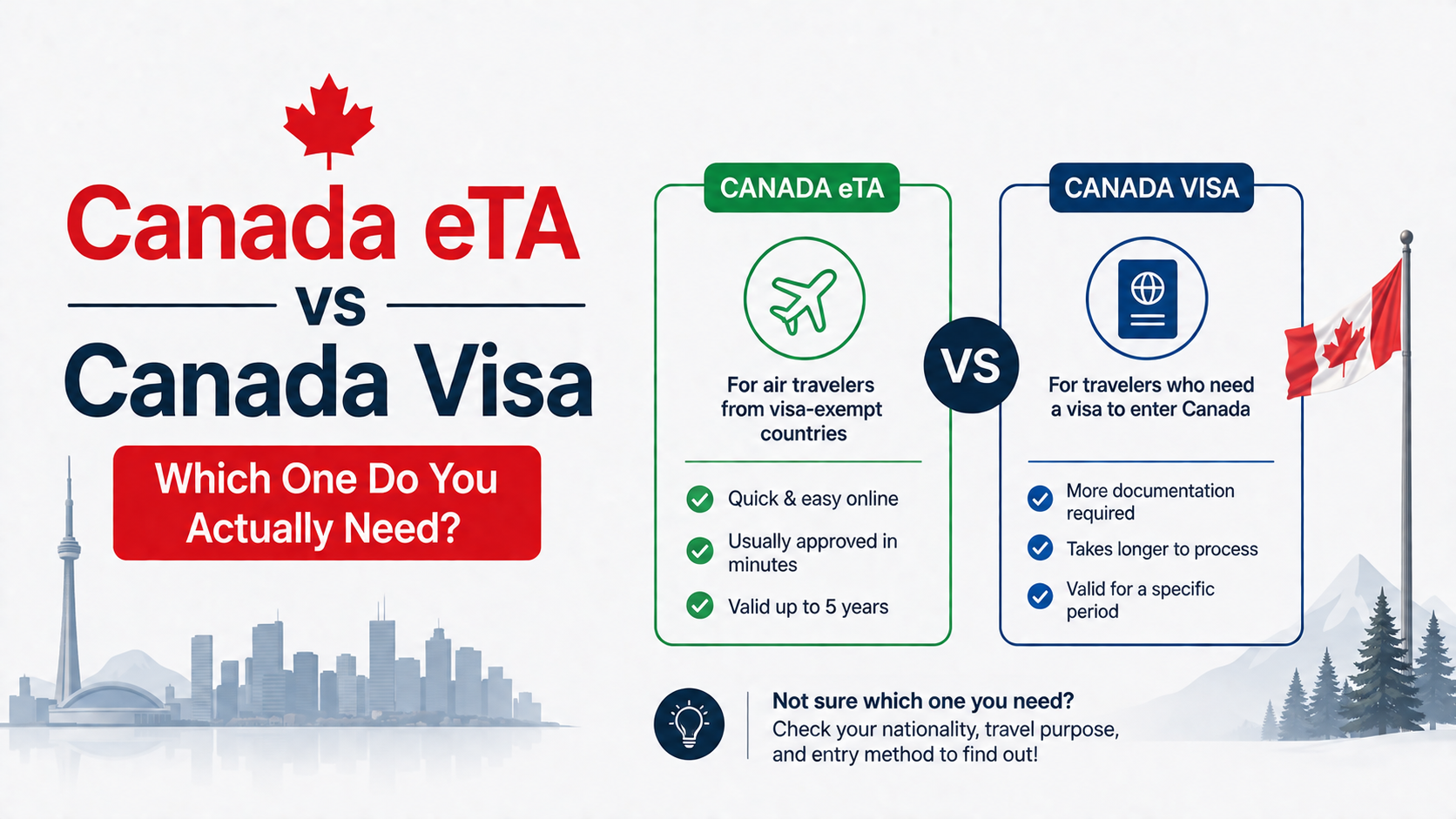
Ask ten travellers whether Canada requires a visa or an eTA, and you’ll likely get several different answers, none of them wrong exactly, just describing different situations. That’s because the two documents aren’t interchangeable options you get to pick between. Which one applies to you comes down entirely to your passport, not your preference.
This comparison lays out exactly how a Canada eTA differs from a Canada visitor visa, what each one actually involves, and how to know which one you need before you book a flight.
The Electronic Travel Authorization, or eTA, is a digital entry requirement for citizens of visa-exempt countries flying to Canada. It’s linked directly to your passport number rather than existing as a physical document, and it’s designed to be quick, usually approved within minutes of applying online. Britain, along with most of the EU, Australia, Japan, and several dozen other countries, falls into this visa-exempt category, meaning an eTA is what’s required, not a full visa.
The Canada visitor visa, formally called a Temporary Resident Visa or TRV, is required for citizens of countries that Canada considers visa-required. Unlike the eTA, a TRV involves a more thorough application, typically including supporting documents such as proof of funds, evidence of ties to your home country, and sometimes an invitation letter, along with biometrics in many cases. It’s the older, more traditional route into Canada, and it applies regardless of whether you’re arriving by air, land, or sea.
Neither document is something you get to choose based on convenience. Your citizenship determines which one applies, and there’s no version of “I’d rather just get the eTA” if your passport falls into the visa-required category. The two systems exist specifically to treat different nationalities differently, based on Canada’s own risk and reciprocity assessments.
There is one narrow exception worth knowing about. Citizens of certain visa-required countries can apply for an eTA instead of a full visa if they’re flying directly to Canada, hold a valid US visa or have held a Canadian visitor visa within the past ten years, and their country appears on a specific eligible list. This applies to a limited set of nationalities, so it’s worth checking current eligibility carefully rather than assuming it applies.
| Factor | Canada eTA | Canada Visitor Visa (TRV) |
|---|---|---|
| Who needs it | Citizens of visa-exempt countries, including the UK, most of the EU, Australia, and Japan | Citizens of visa-required countries |
| Format | Electronic authorization linked to your passport number | Document or sticker linked to your passport |
| Modes of travel covered | Air travel only | Air, land, and sea |
| Typical cost | CAD $7 | CAD $100 |
| Typical processing time | Minutes, occasionally a few days | Several weeks, varying widely by country and volume |
| Application process | Short online form | Online or paper application, supporting documents, often biometrics |
| Validity once approved | Up to five years or until the passport expires | Often up to ten years, single or multiple entry depending on the decision |
| Stay allowed per visit | Typically up to six months, at officer discretion | Typically up to six months, at officer discretion |
| Supporting documents needed | None beyond passport details and payment | Proof of funds, travel history, ties to home country, sometimes an invitation letter |
| Guarantees entry to Canada | No | No |
The eTA process is built for speed. You fill out a short form with your passport and personal details, pay the fee, and in most cases get a decision before you’ve finished your cup of tea. There’s no interview, no biometrics appointment, and no need to submit bank statements or supporting letters.
A visitor visa application asks a lot more of you. Officers reviewing a TRV need to be satisfied that you’re a genuine visitor who intends to leave Canada at the end of your stay, so the application typically requires evidence of financial means, a clear travel purpose, and sometimes documentation showing strong ties to your home country, such as employment or property. Many applicants also need to attend a biometrics appointment at a visa application centre, which adds both time and an extra step to the process.
The gap between the two is significant. An eTA costs a flat CAD $7 and is usually resolved within minutes. A visitor visa costs CAD $100 and can take anywhere from a few weeks to several months depending on the country you’re applying from and how busy that visa office happens to be. Neither fee guarantees approval, since both are simply the cost of having your application reviewed.
It’s worth being clear about the limits that apply to both documents equally:
If you’re travelling on a British passport, or one from most of the EU, Australia, New Zealand, Japan, or South Korea, you’re in the visa-exempt category, which means the eTA is what applies to you for flights into Canada. There’s no visa route available or needed in this case, and applying for one instead of the eTA isn’t an option.
If your passport falls into the visa-required list, a Temporary Resident Visa is what you’ll need, unless you happen to qualify for the narrow eTA exception mentioned earlier. The safest way to confirm which category applies to you is to check your specific nationality against Canada’s current entry requirements rather than assuming based on what a friend or family member needed.
Can I apply for a Canada visa instead of an eTA if I’d prefer the flexibility? No. Eligibility is based on your passport’s visa status, not personal preference, so visa-exempt travellers use the eTA system and nothing else.
Is a Canada eTA cheaper because it’s a lesser document? Not exactly. It’s cheaper because it’s a lighter pre-screening process rather than a full visa assessment, reflecting the lower-risk classification of visa-exempt nationalities rather than a difference in the trip itself.
Does holding a visitor visa mean I never need an eTA? Correct, you only need one or the other, never both. If you already hold a valid TRV, applying for an eTA as well isn’t necessary.
If my visa or eTA is approved, am I guaranteed entry to Canada? No. Both documents allow you to travel to the border, but a border services officer makes the actual entry decision when you arrive.
Once you know an eTA is the right document for your trip, the process itself should be quick and painless, and that’s exactly where we come in. At EasyCanadaETA.com, we help travellers, including the many British citizens who fall squarely into the eTA-eligible category, apply correctly the first time, with every detail reviewed before submission and support available if anything needs following up. Start your Canada eTA application with us and skip the guesswork about whether you’ve got the right document.